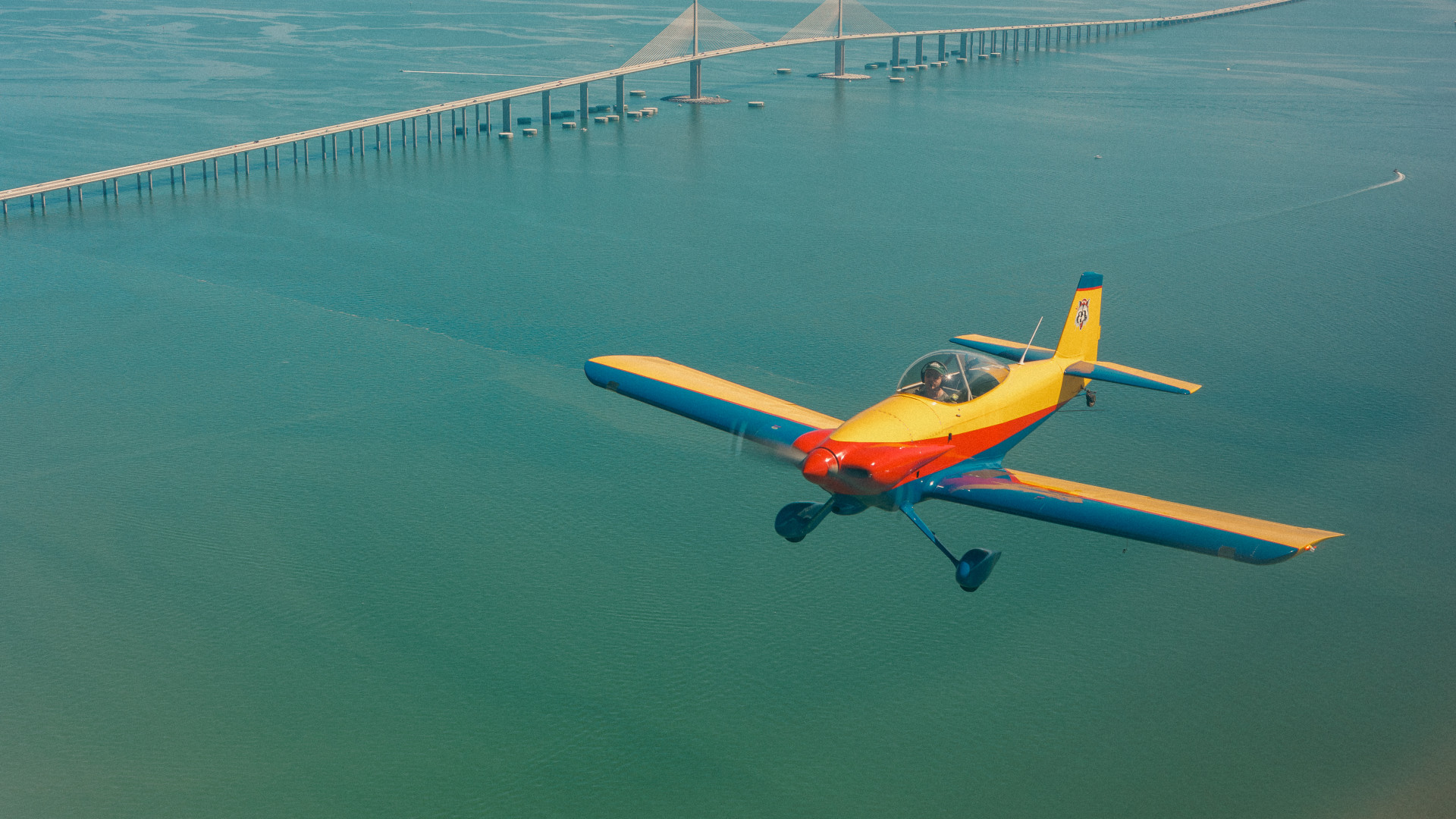
If you've ever watched an experienced tailwheel pilot grease a three-point landing, it looks almost effortless — the mains and tailwheel kiss the runway simultaneously, the airplane settles, and it's over. What you're watching is actually a precise coordination of energy, pitch, and timing. Here's what's going on under the hood.
What "Three-Point" Actually Means
A three-point landing is one where all three wheels — the two main gear and the tailwheel — contact the runway at the same moment. This happens at a specific pitch attitude that is, not coincidentally, very close to the airplane's stall attitude. The goal is to arrive at that attitude just as the last of the lift bleeds away, letting the airplane settle onto all three points simultaneously with minimal vertical speed.
This is distinct from a wheel landing, where the mains touch first at a flatter attitude and the tail is flown onto the ground afterward. Both are valid techniques, but the three-pointer is the one most beginners learn first — and the one that takes the longest to truly master.
The Energy Picture
Everything in landing is energy management. As you cross the threshold, you're carrying kinetic energy (airspeed) and potential energy (altitude). Your job on final is to arrive at the numbers with just enough of both — enough airspeed to flare, enough altitude to use it.
In a tailwheel airplane, this matters more than in a nosewheel aircraft because the margin for error is tighter. Too fast and you'll float down the runway, touching down with excess energy that the airplane would rather use to fly. Too slow and the flare goes flat, the tail drops prematurely, and the mains hit hard before you're in the right attitude.
The Flare
The flare begins as you approach the runway surface — typically initiated somewhere between 10 and 20 feet AGL depending on the airplane. You're gradually increasing back pressure to arrest the descent rate and simultaneously reducing power (if you haven't already).
The goal of the flare is to trade your remaining airspeed for pitch attitude. As the nose comes up, lift temporarily increases, slowing the descent. Then, as the airspeed bleeds off, lift drops away. If the timing is right, the airplane reaches its three-point attitude — nose high, tail low — just as it runs out of flying speed. That's your touchdown.
The most common mistake here is rushing it: hauling back too quickly, pitching up before the airplane is low enough, and then ballooning back into the air with nowhere to go but down.
The Hold-Off
Between the flare and the touchdown is the hold-off — the phase where you're maintaining the landing attitude while the airplane slowly settles. This is where patience separates good tailwheel pilots from great ones.
You're holding back pressure to keep the nose up, working the rudder to stay aligned with the centerline, and resisting the urge to force the airplane onto the runway. The goal is to hold that three-point attitude just above the surface until the airplane flies itself onto the ground. When it's done right, you may not even feel the moment of touchdown.
Why the Tailwheel Makes It Harder
In a nosewheel airplane, a slightly nose-low attitude at touchdown isn't catastrophic — the nosewheel absorbs the error. In a tailwheel airplane, touching down in anything other than the correct attitude invites trouble.
Touch down on the mains alone with the tail too high, and the airplane's center of gravity — which sits behind the main gear — wants to keep rotating forward. This is the setup for a ground loop: a rapid, often uncontrollable swing that can depart the runway in a hurry.
This is why directional control after touchdown is just as critical as the landing itself. Stay on the rudder, keep the tailwheel on the ground, and fly the airplane until it's parked.
When It All Comes Together
A perfect three-point landing feels like the runway comes up to meet you. There's no definitive thud, no bounce, no sudden deceleration — just a smooth transition from flying to rolling. The airplane is at its minimum flying speed, in its landing attitude, aligned with the runway, with the energy mostly spent.
It takes time. It takes repetition. And it takes an instructor who can talk you through what you're feeling in real time — because in a tailwheel airplane, you feel everything.
Three Point Aero Services specializes in tailwheel instruction and endorsements. Ready to get started? Contact us today.